How JET works
JET evaluates any piece of online content by applying established journalistic principles across four structured layers. The result is a credibility score — and a transparent, challengeable explanation of why that score exists.
This page explains the framework: what JET looks at, what it measures, and how it arrives at an output. It is designed to be rigorous and open to scrutiny.
The Framework —
Four Layers of Analysis
Every piece of content on the internet exists within a structure. JET makes that structure visible by analysing four distinct layers — from the content itself to the platform that hosts it. Each layer carries its own signals of accountability.
Layer 02 - AuthorThe individual or entity responsible for creating the element. Who produced this, and are they accountable for it?
Layer 03 - PublicationThe organisation or brand under which the element is published. What are its ownership, funding and editorial structures?
Layer 04 - PlatformThe service on which the content is hosted — YouTube, Substack, an independent site. What are its editorial and algorithmic incentives?
Layer 01 - ElementThe content itself — an article, video, podcast, or post. What is being said, and how is it supported?
The Standard — Three Principles of Journalism
JET measures each layer against three core journalistic principles. These are not arbitrary. They are drawn from the profession's own documented consensus — the result of four years of research, national forums, and hundreds of journalist interviews, codified in one of the most widely translated texts in journalism education.
Primary source
The Elements of Journalism: What Newspeople Should Know and the Public Should Expect
Bill Kovach & Tom Rosenstiel — translated into 25+ languages, used in journalism schools worldwide
Claims are cited with relevant and reliable sources. Original reporting is transparent by disclosing the reporter, editor and the source. If the source is not disclosed, that decision is defended.
Editor and editorial process, funding, business structure, and conflicts of interest are disclosed. The structures that shape information production are visible.
The publication and platform are independent from power structures — governments, corporations, and individuals — whose influence would distort accountability journalism.
1
Why these three principles and not others
Kovach and Rosenstiel's work emerged from the Committee of Concerned Journalists — a group of 25 senior journalists who spent four years researching what the profession's own standards actually were. The resulting framework represents journalism's self-assessed consensus, not an external standard imposed upon it. JET chose this source precisely because it is difficult to argue with: it is the field defining itself. Of the nine principles identified, JET focuses on the three that are structural and measurable — the ones that can be assessed without adjudicating the content's political or ideological framing.
Does JET evaluate whether journalism is good journalism?
2
No. JET evaluates whether journalism meets structural standards of accountability — not whether it is well-written, fair, or ideologically sound. A piece of content can score well on JET's framework and still be badly argued. JET equips users to assess credibility; it does not replace editorial judgment or citizen reasoning.
Does JET apply these principles to all content types?
3
JET applies its framework to any element — articles, video, podcasts, social media posts — but calibrates expectations to the format and classification of the content. A personal opinion piece is held to different standards than an investigative report. The classification system within the Element layer ensures that context shapes evaluation.
The Pipeline —
How JET arrives at a score
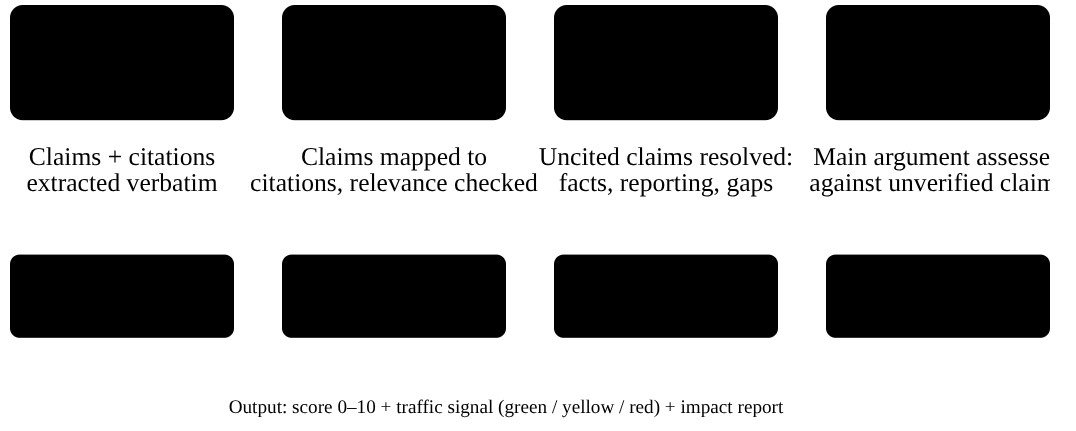
The evaluation of any element moves through four structured phases. Each phase builds on the one before it, ending in a score and an impact report that explains exactly where credibility concerns lie.
The Output — What JET Produces
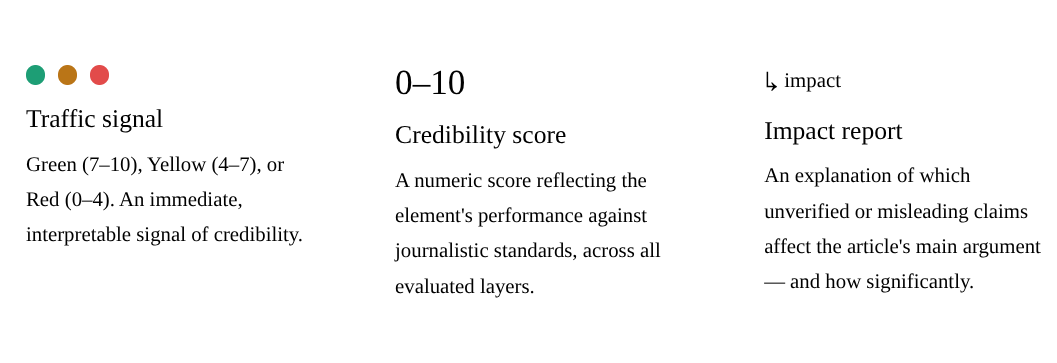
Every evaluation produces three outputs. Together, they give a user not just a verdict, but a map of where credibility concerns lie and how much they matter.